
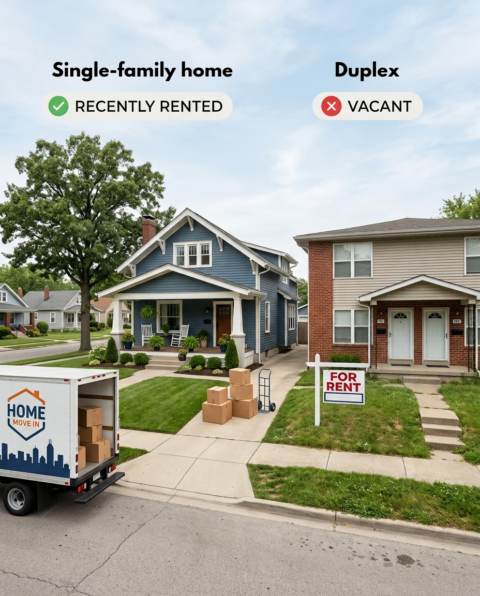
Why Your Indianapolis Duplex Is Sitting While Single-Family Rentals Lease
If you own a duplex or small multifamily property in Indianapolis, you may have noticed something that does not add up. Your listing gets inquiries. The emails come in and the online interest is there. Then very few of those people book a showing.
Meanwhile, the single-family side of the market is leasing faster than it did a year ago, at higher rents.
You are not imagining it, and it is not only your listing. Indianapolis is not one rental market right now. It is two, and they are moving in different directions. Understanding which one your property sits in changes how you price it, how you market it, and what you should expect over the next several quarters.
Two Rental Markets Under One Name
Our Q3 2026 Marion County rental market report tracks residential leases recorded in the Indianapolis MLS. That data skews heavily toward single-family homes, so it is the best read we have on that side of the market. In Q3 2026, lease volume dropped 23.5%. Homes still leased faster, and rents went up.
That combination matters. When fewer leases close but the ones that do close go faster and for more money, demand is not the problem. Supply is. There are not enough single-family rentals to go around, and owners of well-kept houses in ZIP codes like 46219, 46227, and 46205 are in a strong position. If you followed our first-half 2026 market report, you saw how slow the early months of the year were. The single-family market has worked through that.
The apartment market tells a different story, and that story reaches down to duplexes, triplexes, and quads.
What the University of Denver Cycle Monitor Shows
The Real Estate Market Cycle Monitor, published by Glenn Mueller, Ph.D., and Ryan Chacon, Ph.D., at the University of Denver’s Franklin L. Burns School of Real Estate and Construction Management, tracks occupancy and rent growth for five property types across 56 metro areas. It places each market in one of four phases of the real estate cycle.
In the Fourth Quarter 2025 analysis, published in February 2026, Indianapolis apartments sit in Phase 4, Recession. The market is at position 16, the last point on the cycle before it reaches bottom and restarts in Recovery. Indianapolis moved forward one position from the prior quarter, meaning conditions progressed further into the downturn rather than improving.
| Phase | What Happens to Supply and Demand | What Happens to Rents |
|---|---|---|
| Phase 1: Recovery | Occupancy starts at its low point. Demand slowly absorbs excess space while little new construction comes online. | Rents stabilize, then grow slowly, typically at or below inflation. |
| Phase 2: Expansion | Demand outpaces supply. Occupancy rises above the long-term average. | Rents rise quickly until new construction becomes feasible. |
| Phase 3: Hypersupply | New construction delivers faster than demand grows. Vacancy rises back toward the long-term average. | Rent growth stays positive but slows. |
| Phase 4: Recession (Indianapolis apartments) | Occupancy falls below the long-term average. Supply growth is high while demand growth is low or negative. | Rent growth falls below inflation or turns negative. Landlords compete on price. |
The report’s description of Phase 4 is blunt. Landlords who fear losing market share “lower rents to capture tenants, even if only to cover their buildings’ fixed expenses.” The authors also note that market liquidity is low in this phase because buyers and sellers are too far apart on price.
The national apartment section of the same report adds useful context. Newer buildings have been pulling tenants away from older ones by reducing asking rents and offering free rent to fill units and satisfy their lenders. In some markets, that free rent has reached as much as 2.5 months on a one-year lease. That is a national observation, not an Indianapolis figure, but it describes the competition a small multifamily owner is up against.
Local Data Points to the Same Conclusion
The Cycle Monitor is not the only source showing pressure on Indianapolis apartments. CoStar reported in August 2026 that developers have added nearly 20,000 apartments across the Indianapolis area over the past five years, pushing vacancy above 10%. Earlier in the year, CoStar reported that new supply was outpacing demand and had pushed vacancy to its highest level in more than a decade.
Rents reflect that. Apartment List’s October 2026 rent report puts the Indianapolis citywide median rent at $1,239, down 0.3% from a year earlier. Rents rose 1.7% over the first nine months of 2026, slower than the 2.4% increase over the same months of 2025. Flat rents in a market where operating costs keep rising is what Phase 4 looks like in practice.
Why a Duplex Feels an Apartment Recession
The Cycle Monitor measures the apartment market. It does not track duplexes directly. So why would a duplex owner in 46201, 46218, or 46222 feel it?
Because renters do not shop by property type. They shop by price, bedroom count, and location. A tenant looking at a two-bedroom duplex unit is often looking at two-bedroom apartments in the same price range at the same time. When a newer complex across town is offering a free month, a fitness room, and a leasing office open on Saturday, your duplex unit is being compared against that offer whether you like it or not.
A single-family house is a different product. A renter who needs a yard, a driveway, and no shared walls usually is not choosing between your house and an apartment. That is a big part of why the two markets have separated.
What We Are Seeing in Our Own Portfolio
This section is our own observation, not market data, and it should be read that way.
The duplexes we currently have listed are generating leads. They are not converting those leads into viewings at the rate we would expect. Prospects inquire, then go quiet. Our active listings are a small sample, and a small sample cannot prove anything about the city as a whole. What we can say is that this pattern is consistent with what Phase 4 looks like on the ground: renters have more options, they are comparing more carefully, and an inquiry is no longer a commitment to show up.
| Segment | What We Know | Source |
|---|---|---|
| Single-family rentals, Marion County | Lease volume down 23.5% in Q3 2026, with faster leasing and higher rents | Indianapolis MLS, SRH Q3 2026 market report |
| Indianapolis apartments | Phase 4, Recession, position 16 of the cycle | University of Denver Real Estate Market Cycle Monitor, Q4 2025 analysis |
| Indianapolis area apartment vacancy | Above 10% after nearly 20,000 units added in five years | CoStar, August 2026 |
| Indianapolis citywide median rent | $1,239, down 0.3% year over year | Apartment List, October 2026 |
| Duplexes in the SRH portfolio | Leads coming in, few converting to viewings | SRH internal observation (anecdotal) |
Get Your Property Analysis
What Duplex and Small Multifamily Owners Should Do Now
None of this means your property is a bad investment. It means the playbook that worked in 2022 does not fit the market your units are competing in today. Here is what we are doing for the small multifamily properties we manage.
Price against today’s competition, not last year’s lease
The rent your last tenant paid is not a comp. Neither is a listing that has been sitting for 60 days. Our $5 Comparative Market Analysis pulls active, pending, and closed leases within a quarter mile over the last six months, so pricing reflects what renters are actually signing now. In a Phase 4 market, also look at what nearby apartment complexes are offering, including move-in specials. That is who your prospects are comparing you against.
Run the concession math before cutting rent
Here is an illustrative example using a hypothetical $1,000 per month unit. Cutting the rent by $75 costs $900 over a 12-month lease, and it lowers the base that every future increase builds on. Every lease we write includes a minimum 4% annual increase, so a lower starting rent follows the unit for years. A one-time concession of half a month’s rent costs $500, and the lease rent stays at $1,000. On the other side of the ledger, every month that unit sits empty costs the full $1,000. A concession that gets the unit leased a month sooner can pay for itself. Your numbers will differ, so run them on your actual rent and your actual days on market.
Close the gap between inquiry and showing
When prospects inquire and disappear, the listing is making the shortlist but losing at the next step. Respond quickly, make showings easy to schedule, and give remote prospects a reason to stay interested. We shoot HD video walkthroughs of every listed property and send owners weekly status reports while it is on the market, so you can see lead counts and showing activity instead of guessing.
Protect the tenants you already have
In urban core Indianapolis rentals, a tenant turn typically runs $6,000 to $8,000. Interior paint alone is about $3,000 in 2026. In a market where the next tenant may take longer to find and may need a concession, a renewal is worth even more than usual. Our multifamily tenants stay an average of 3.93 years. Reach out to good tenants before their lease is up, fix the small things they ask about, and make renewing the easy choice.
Do not loosen screening to fill a unit
The pressure to approve a marginal applicant is strongest when a unit has been sitting. Resist it. A bad tenant in eight months can trigger the same turn cost as four years of normal wear, plus the lost rent of an eviction. We run manual court record searches and verify paystubs against bank statements, and our eviction rate stays below 2%. A slow market is not the time to relax that.
Do not sell into the bottom without running the numbers
The Cycle Monitor notes that liquidity is thin in Phase 4 because the gap between what buyers will pay and what sellers will accept is wide. Selling now often means accepting the buyer’s side of that gap. The same report explains how the cycle turns: the bottom arrives when new construction and completions stop, or when demand starts growing faster than new supply. Indianapolis sits at the last position before that point. Nobody can tell you exactly when the turn comes, but owners who can carry the property through it are not selling at the worst point in the cycle.
Setting Realistic Expectations
If you own small multifamily in Indianapolis right now, expect units to take longer to lease than they did a few years ago, and be prepared to compete on price, concessions, or condition. If you also own single-family rentals, do not judge one by the other. Your houses may be performing well while your duplex sits, and both of those can be true at the same time. You can find every quarterly report in our Indiana rental market reports hub.
The owners who come through this phase in good shape are the ones who price to the market they are actually in, keep their good tenants, and do not let vacancy pressure push them into a bad approval or a rushed sale.
If your duplex is getting inquiries but not showings, it needs a plan built for a Phase 4 market, not a 2022 one. Call 317-537-7249 for a straightforward conversation about your properties. Prefer email? Reach Lee directly at Lee@SpousesRentingHouses.com.