
Investor Closing Checklist: Indianapolis Rental Properties
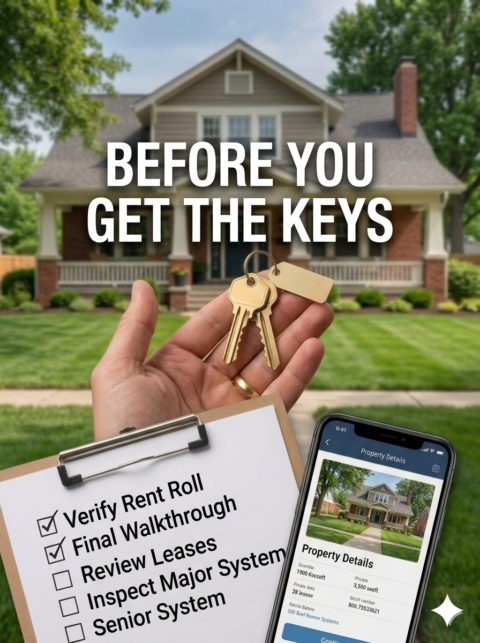
The Real Estate Investor’s Closing Checklist: What to Verify, Capture, and Set Up Before You Get the Keys
Most closing mistakes do not happen at the closing table. They happen in the weeks before it, when an investor assumes something has been handled that has not, or after it, when the new owner discovers a problem that was visible during due diligence but never documented. By the time you are sitting across from the title company, the window to negotiate corrections is effectively closed. What you have is what you bought.
This checklist is written for investors buying single-family homes and small multifamily properties in the Indianapolis market – the kind of asset that will be rented immediately after closing, often managed from another state, and held as part of a longer-term portfolio strategy. The items here reflect what experienced investors routinely miss and what the most expensive post-closing surprises tend to have in common: something that was knowable before closing but was not known.
Before You Schedule the Final Walkthrough
The final walkthrough is not the time to discover problems for the first time. It is the time to confirm that previously identified problems have been resolved and that no new ones have appeared since your last visit. That distinction matters. If you are finding things at the final walkthrough, you are already behind.
Before that walkthrough, verify the following:
Title search and insurance commitment. Confirm that the title commitment has been issued, that you have reviewed it, and that any exceptions noted in Schedule B are acceptable to you. Title exceptions do not disappear at closing – they transfer with the property. Easements, encroachments, and recorded liens that survive closing are your responsibility the moment you sign. If something in the title commitment is unclear, ask the title company to explain it in plain language before closing day.
Do not skim Schedule B. Title companies will find open orders against a property – lead-based paint violations, trash and debris orders, board-up orders, code enforcement citations – and they will list them as exceptions in the commitment. That disclosure is technically accurate. What some title companies will not do is flag those exceptions in a way that makes their significance obvious. You can receive a commitment with an active city code enforcement order buried in a list of standard easements, and unless you read every line, you may not see it until you own the property and the city sends you the bill. Read every exception. Ask what each one means and what it will cost you to resolve it before closing.
Survey. In Marion County and surrounding areas, surveys are not always required for residential closings. That does not mean they are unnecessary. If you are buying a property with a detached garage, a fence line, or any structure that sits close to a property boundary, a survey before closing is money well spent. A fence that encroaches on a neighbor’s property or a garage that sits inside a setback is your problem once you own the property.
All outstanding permits and open orders are resolved. Search the Marion County or Hamilton County building department records for open permits on the property. A previous owner who pulled a permit for an addition, HVAC replacement, or electrical work and never scheduled a final inspection leaves you with an open permit that can complicate your future work on the property, your ability to resell it, and in some cases your ability to rent it legally. Closed permits only – confirm this before closing.
Beyond permits, search for open code enforcement orders through the relevant municipality. In Indianapolis, properties in lower-income urban core neighborhoods can carry active orders for issues like exterior debris, unsecured entry points, or conditions flagged during a prior inspection. These orders follow the property to the new owner. A board-up order on a rear window, a lead-based paint citation triggered by a prior tenant complaint, or an open trash abatement order are all things that may appear in the title commitment as Schedule B exceptions – and all of them become your compliance responsibility at closing if you do not address them first. Confirm with your title company and independently through the city’s code enforcement records that no open orders exist before you sign.
Certificate of occupancy and rental registration. Indianapolis and many of its surrounding municipalities require rental properties to be registered and, in some cases, to hold a valid certificate of occupancy before tenants can legally occupy them. Marion County has specific requirements around rental registration for properties in ZIP codes like 46201, 46218, 46219, 46205, 46208, and 46222. Understand what is required in the specific municipality where the property sits before you close, not after. Renting a property that is not properly registered is an enforcement risk that belongs entirely to the owner.
HOA governing documents, if applicable. If the property sits inside a homeowners association, request the full governing documents – CC&Rs, bylaws, rules, and current fee schedule – before closing. Review them specifically for rental restrictions. Some HOAs cap the percentage of properties that can be rented at any time. Others require owner approval, tenant background check submissions to the HOA, or minimum lease terms. In Hamilton County markets like Fishers (46037, 46038) and Carmel (46032, 46033), HOA rental restrictions are an active issue and are not always disclosed proactively. Knowing before you close is the only way to know before it costs you.
The Final Walkthrough: What to Capture, Not Just See
The final walkthrough serves two purposes for an investor. The first is confirming condition. The second – and the one most investors underuse – is creating a baseline record of the property at the moment of transfer. That baseline matters when a tenant later claims a condition existed before their tenancy, when an insurance claim requires documentation of pre-loss condition, and when you need to establish what was and was not present when you acquired the asset.
Walk the property with video running. Every room, every system, every exterior surface. This is not about finding problems for the seller to fix at this point – it is about creating a timestamped, visual record of what you received. If you are buying a property in a lower-income urban core neighborhood in Marion County, the condition at acquisition is the baseline everything else is measured against. Document it as if you will need to prove it in a dispute, because at some point you likely will.
During the walkthrough, specifically check and document:
All appliances present and operational. Turn on every appliance included in the sale. Run the dishwasher through a cycle. Run the garbage disposal. Check burners on the range. Confirm that the appliances actually work, not just that they are present. A contract that includes appliances does not guarantee they function.
All systems: HVAC, water heater, plumbing, electrical. Turn the heat and cooling on and confirm air is moving through every vent. Run water at every fixture and check under sinks for evidence of active or recent leaks. Flush every toilet. Confirm the water heater is operational and note its age – anything over ten years is a near-term capital expense. Check the electrical panel for any breakers that are doubled up, any that have been switched off and left that way, or any obvious DIY wiring work.
All exterior entry points lock and function. Every door, every window. This matters for insurance purposes and for the habitability requirements that apply once you place a tenant. A window that will not latch or a door that does not close flush is a problem that tenants will document on their move-in inspection. Better to know before they do.
Presence of smoke and carbon monoxide detectors. Indiana law requires working smoke detectors in rental properties. Confirm they are present and test them. Note their locations. This is a basic habitability requirement and one that is entirely within your control to address before closing or immediately after.
Any items the seller agreed to repair or replace. If your purchase contract included seller concessions for repairs, walk the specific items that were negotiated. Get documentation – photos and video – confirming the work was done. If a seller agreed to replace the water heater, confirm a new water heater is installed, not that the old one has been cleaned up to look less worn.
At the Closing Table: Documents to Collect and Review
Several items need to transfer at closing or be confirmed as part of the transaction. Some of these are standard and will be handled automatically. Others require you to ask specifically.
All keys, garage door openers, and access codes. Confirm you are receiving every set of keys the seller has. If the property has a smart lock, keypad, alarm system, or gate code, get the credentials and change them immediately after closing. You do not know how many copies of the old code exist.
Utility account information. Confirm which utilities are in the seller’s name and what the transfer process looks like for each. In Indianapolis, water and sewer accounts through Citizens Energy Group follow the property, not the owner – there is a process for transferring service and confirming no outstanding balance before closing. Do not assume utility transitions happen automatically. Confirm each one explicitly.
Existing service contracts. Ask specifically whether the property has active service contracts – pest control, landscaping, HVAC maintenance agreements, security monitoring. Some of these auto-renew and some of them bind the property owner. Know what you are inheriting before you inherit it.
Warranties on recent work. If the seller replaced the roof, HVAC, or major appliances within the past several years, those warranties may be transferable to the new owner. Ask for documentation of any work done within the past five years and the accompanying warranty paperwork if available. A transferable roof warranty has real value that does not automatically come with the property – you have to ask for it.
If the property is tenant-occupied: the full lease package. This requires its own section.
Buying a Tenant-Occupied Property: The Additional Layer
Acquiring a property with an existing tenant is not inherently a problem. A good tenant in place can mean immediate cash flow and a reduced turn cost. It can also mean inheriting a problem that the seller was motivated to pass along. The only way to know which situation you are walking into is to review the lease and tenant file thoroughly before closing, not after.
Collect and review before closing:
The signed lease agreement in full. Read it. All of it. Note the lease end date, the rent amount, any concessions the landlord made (first month free, reduced deposit, included utilities), and any provisions that are unusual or that would be inconsistent with how you intend to manage the property going forward. You are buying the lease, not just the property. The tenant’s rights under that lease transfer with the sale.
Rent roll and payment history. Confirm the tenant is current on rent. Ask for a 12-month payment history and look for patterns – consistent on-time payment is the baseline you want to see. Late payments that have been waived, partial payments, or any period where the rent was below what the lease specifies are all worth understanding before you close.
Security deposit transfer. The seller must transfer the security deposit to you at or before closing. This is not optional. In Indiana, the security deposit belongs to the tenant and you become the holder of it the moment you acquire the property. If you close without confirming the deposit has been transferred, you have taken on the liability of returning it at move-out without holding the funds.
Prorated rent on the closing statement. If a tenant is in place and has already paid rent for the month in which you close, the rent needs to be prorated on the settlement statement – the seller keeps the portion covering the days they owned the property, and the remainder is credited to you as the new owner. This does not happen automatically. It requires that someone – your agent, your title company, or you – raises it before the closing statement is finalized. If no one asks, the proration may simply be left off. Review the closing disclosure carefully before signing and confirm that any rent collected by the seller for days you will own the property has been credited to you. Some buyers negotiate to waive prorated rent as part of the purchase terms, which is a legitimate choice – but it should be a deliberate choice, not an oversight.
Estoppel certificate from the tenant. An estoppel certificate is a signed statement from the tenant confirming the lease terms as the tenant understands them – the rent amount, the lease dates, whether any concessions were made, and whether the landlord owes the tenant anything. It protects you from a tenant who later claims the prior landlord made verbal promises or side agreements that are not in the written lease. Request one before closing. Not every transaction will produce one, but asking for it is always worth doing.
Verify the tenant’s income and screening documentation. Ask the seller for the original application, screening results, and income verification documents used when the tenant was placed. Fabricated paystubs and manipulated income documents are more common than most landlords expect – knowing how the tenant was originally screened tells you something important about the risk you are inheriting.
Get Your Property Analysis
Immediately After Closing: The First 72 Hours
What you do in the first three days after closing sets the operating baseline for the property. Several things need to happen quickly, and each one that gets delayed creates a gap that is harder to close later.
Change all locks and access codes. Every exterior lock, every keypad, every garage code, every alarm pin. You do not know who has keys to the property – prior tenants, contractors, neighbors the seller gave a spare to. This is not optional and it is not expensive. Do it before anything else.
Transfer all utilities into your name or your management company’s name. Contact each utility provider and confirm the transfer. In Indianapolis, this includes Indianapolis Power and Light (now AES Indiana) for electric, Citizens Energy Group for gas and water, and whatever provider handles internet and trash collection for the specific address. Do not assume this happens automatically because the closing statement addressed it.
Conduct and document a full property condition assessment. If you did not video the walkthrough before closing, do it now – the day you get the keys. This is your baseline. Every scratch, every scuff, every cosmetic issue. If the property will be vacant before a tenant moves in, this documentation protects you when a tenant later claims damage existed before their tenancy. If a tenant is already in place, a move-in inspection with the tenant present and signed by both parties is the correct next step.
Our $100 HD Video Assessment covers exactly this – a thorough video walkthrough of the property pointing out every visible issue, creating a scope of work for anything that needs attention and a documented record of condition at the time of acquisition. For an out-of-state investor closing on an Indianapolis property who cannot be there in person, this is the practical alternative to being present yourself.
Register the property for rental if required. In Marion County, properties in certain ZIP codes require registration with the city before they can be legally rented. Confirm the specific requirements for the address you just acquired and complete registration before placing a tenant. The process is not complicated but it must be done in the correct sequence – doing it after a tenant is already in place is a compliance gap you do not need.
Enroll in the county Property Fraud Alert program. This is particularly relevant for out-of-state owners. The Marion County Recorder’s Office offers a free alert service through propertyfraudalert.com that notifies you when any document is filed in your name with the recorder’s office. Given that deed fraud specifically targets rental properties with absentee owners, enrolling immediately after closing is a straightforward protective step. Properties in Hamilton County (46037, 46038, 46032, 46033, 46060) and Hancock County have their own alert programs through the same system.
Confirm your landlord insurance is active and correctly bound. A standard homeowner’s policy does not cover a rental property. A landlord or dwelling fire policy is the correct product. Confirm the policy is in force as of the closing date, that the coverage amounts are adequate, and that your lender (if applicable) is listed as an additional insured on the policy. An uncovered loss in the first week of ownership is a worst-case scenario that is entirely preventable.
Setting Up Management Before You Need It
The investors who have the smoothest first placements on a new Indianapolis property are the ones who had a property manager engaged before closing, not after. The timeline matters. A property that sits vacant while an out-of-state owner figures out who to call costs money every day – Marion County rents for a typical urban core single-family home run around $1,100 per month, which is roughly $37 per day in lost revenue while the property sits empty.
Engaging a property manager before closing means your $5 Comparative Market Analysis can be run during due diligence, giving you current rental comps within a quarter mile of the address before you finalize the purchase price. It means the HD Video Assessment can happen on the day of closing, not two weeks later. It means the property can be listed and marketed the moment it is ready rather than after an owner has spent several weeks figuring out the local process from another state.
The real cost of self-managing an Indianapolis rental is not just the time it takes to handle tenant calls and coordinate maintenance. It is the cost of the learning curve on a property type, in a market, with local requirements that are specific and consequential. A closing that went smoothly can still produce a difficult first year if the post-closing setup is handled incorrectly.
We have managed single-family homes and small multifamily properties across Marion, Hamilton, and Hancock Counties since 2007. We know the rental registration requirements by ZIP code, the HOA dynamics in specific Hamilton County subdivisions, what a realistic rent looks like for a property in 46219 versus one in 46032, and how to screen a tenant in a way that produces a 4.2-year average retention rate rather than a revolving door. That institutional knowledge is available to you from day one of ownership if you engage before you close rather than after.
Call 317-537-7249 to talk through a property you are under contract on or have recently closed. Prefer email? Reach Lee directly at Lee@SpousesRentingHouses.com. No sales pitch – just a straightforward conversation about the property, the market, and whether the numbers work the way you are expecting them to.