
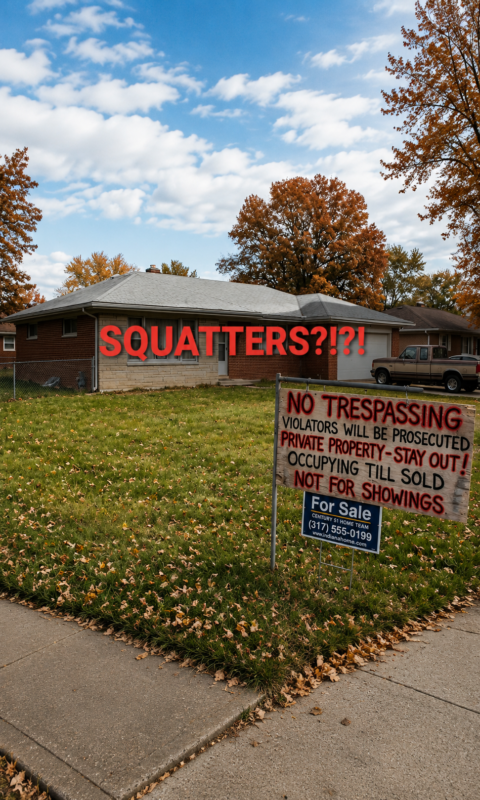
Indiana Squatter Law 2025: What Indianapolis Landlords Need to Know
Understanding Indiana’s Squatter Law: What It Does, What It Doesn’t, and Where Your Real Exposure Still Lives
You find out someone is living in your vacant rental property in 46218. You have been out of state for months. The unit was supposed to be empty between tenants. Now it is not, and you have no idea how long they have been there.
That scenario used to mean one thing: you were about to spend weeks, possibly months, navigating the court system to get your own property back. Indiana just changed that.
As of July 1, 2025, Senate Enrolled Act 157 (P.L. 191-2025, Indiana Code 32-31-12) is in effect. It is the most significant shift in Indiana property law for landlords and investors in years. If you own rental property in Indianapolis, Marion County, or the surrounding areas, you need to understand exactly what this law covers and – more importantly – what it does not.
What Indiana’s 2025 Squatter Law Actually Does
Before SEA 157, Indiana had no legal definition of a squatter. That gap was a real problem. An unauthorized occupant could claim to be a tenant, and suddenly a property owner was forced into landlord-tenant court procedures even when no lease ever existed. Police would often decline to act without a court order, leaving owners with no fast option.
The recent law closes that gap in three meaningful ways.
Indiana now legally defines a squatter. Under this newly enacted law, a squatter is someone who occupies your property and who does not have, and has never had, a rental agreement, the property owner’s permission, or any other legal interest authorizing them to be there. That definition is specific by design.
Property owners can now use an affidavit process instead of filing a full eviction lawsuit. You execute a sworn affidavit stating that a squatter is occupying your property. Once that affidavit is presented to law enforcement, officers are required to remove the individual within 48 hours. Law enforcement may delay only if exceptional public safety circumstances apply. Officers must remove the person unless they find credible written evidence – such as a current or prior rental agreement – that the individual is not actually a squatter.
New adverse possession claims are eliminated. Prior to this law, someone who occupied a property openly and continuously for 10 years could attempt to claim ownership through adverse possession. Any adverse possession claim filed after June 30, 2025 is no longer permitted under Indiana law. Claims already in progress before that date still proceed under the old rules, but no new claims can be initiated going forward.
These are genuine wins for property owners. The 48-hour removal window alone represents a dramatic shift from what used to be a weeks-long or months-long ordeal in the court system.
The Part of This Law Most Landlords Are Getting Wrong
Read the squatter definition again carefully: someone who does not have, and has never had, a rental agreement or the owner’s permission.
That one phrase is where landlords get into trouble if they misread the law’s reach.
The moment a person has ever had any legal right to occupy your property – even an expired lease, even a month-to-month agreement that ended six months ago – they are not a squatter under this law. They are a former tenant, and removing them still requires the standard Indiana eviction process through the courts.
This matters more than most property owners realize, because the problem scenarios most Indianapolis landlords actually face are not strangers breaking into vacant homes. They are:
- A tenant who stops paying rent and refuses to leave after the lease expires
- A tenant who allows an unauthorized occupant to move in – and then the original tenant leaves while the unauthorized person stays
- A holdover tenant situation where a lease ran out and no formal renewal was executed
None of those situations qualify under the recent squatter law. For all of them, you are still going through the eviction process. This law does not change that.
The squatter law addresses a real and specific threat – someone with zero prior connection to your property taking up residence there. And that threat lives almost entirely in one place: the vacancy window.
If you want to understand how lease management and tenant documentation protect you from the gray areas that even this current law does not cover, the Fishers subletting loophole case is worth reading. It is exactly the kind of unauthorized occupant situation that does not fit neatly into the current squatter definition.
The Vacancy Window Is Where Out-of-State Investors Get Exposed
The 48-hour removal process only helps you if you know there is a problem in the first place.
If you own a rental in 46201, 46222, or 46219 and you live in California, Colorado, or overseas, the stretch of time between tenants is where your property is most vulnerable. A vacant unit can attract unauthorized entry quickly, and you may not find out until the situation has already compounded – a damaged unit, a utility hookup someone ran without authorization, or worse.
Even with the recently enacted law on your side, acting on it still requires someone local who can identify the problem, prepare the affidavit, coordinate with law enforcement, and be ready to handle the property immediately after removal. That is a lot of moving parts for a remote owner to manage from a different time zone.
Out-of-state landlords managing Indianapolis rentals remotely already know that the vacancy period is the highest-risk window in the management cycle. The latest squatter law makes having a local operation watching your property during that window more important, not less.
Get Your Property Analysis
How a Local Property Manager Addresses the Gaps This Law Does Not Cover
The recent squatter law is a useful tool. It is not a property management strategy. Here is what the law does not do: it does not screen tenants before they get a key, it does not enforce lease terms, it does not check on your property during vacancy, and it does not recover the $6,000 to $8,000 a damaged unit costs to turn after an unauthorized occupant has been in it.
That is where day-to-day management either protects you or does not.
We have managed single-family homes and small multifamily properties across Marion, Hamilton, and Hancock Counties since 2007. About 62% of our owners live out of state or internationally. The protections we build into our process are designed around exactly the scenarios this squatter law was written to address – and the ones it was not.
Tenant screening that prevents the problem before the lease is signed. Our sub-2% eviction rate across the portfolio starts with how we screen. Manual court record searches, paystub verification against actual bank statements, and rental history review happen before any applicant gets approved. A bad tenant in eight months triggers the same $6,000 to $8,000 turn cost as four years of normal wear. Screening is where you protect yourself from the tenant-to-holdover situations the squatter law does not cover.
Vacancy protocols that close the window before it becomes a problem. When a unit turns over in 46205, 46208, or 46227, it does not sit dark and unmonitored. We handle HD video walkthroughs, weekly listing status reports, and active oversight of the property between tenants. A shorter vacancy window – and active eyes on the property during that window – is the most direct defense against unauthorized entry.
Lease structure that eliminates the gray area. Because the squatter law only applies when there is no prior rental agreement, how your lease is written, renewed, and closed matters. Every lease we manage includes a 4% minimum annual rent increase, written directly into the agreement. Renewals are handled proactively. Lease expirations are timed strategically to avoid difficult winter turnover seasons. There are no ambiguous holdover situations left unaddressed – the kind that blur the line between former tenant and unauthorized occupant and land you in eviction court instead of the 48-hour affidavit process.
Maintenance transparency that does not give tenants a reason to dispute and stay. We pay the majority of our contractors straight labor. Materials are charged directly to our accounts at Lowe’s, Home Depot, and other suppliers – owners see every receipt. The industry standard is a 50-100% markup on materials above actual cost. We charge labor plus materials at actual cost plus a 20% coordination fee. Tenants who feel respected and see maintenance handled correctly do not manufacture disputes as a reason to stop paying and hold over.
Local presence when you cannot be there. If something looks wrong at your property in 46219 or 46201, we find out quickly. We are not responding from another time zone, and we are not relying on a neighbor to call us. Self-managing a rental from a distance means the vacancy window stays open longer and the exposure stays higher. Local boots on the ground close that window.
We back our tenant placements with a 10-month placement guarantee and charge no management fees during vacancy periods. That aligns our interest directly with yours.
What to Do With This Law Right Now
If you own rental property in Indianapolis and you do not have a documented vacancy protocol in place, that is the first thing to fix. The current squatter law gives you a faster path to resolution when unauthorized occupancy happens. It does not prevent it from happening in the first place.
Familiarize yourself with the affidavit process in your county. Know what law enforcement in Marion County, Hamilton County, and Hancock County requires before they will act under the new statute. Have documentation of your property’s vacancy status, your last lease termination, and your ownership recorded and accessible – not buried somewhere you cannot find it when time matters.
If you are managing remotely and relying on periodic check-ins to catch problems, the gap between check-ins is the gap the recent law was written for. Closing that gap with professional local management is the practical application of what SEA 157 makes possible.
If your property sits vacant without active local oversight, the current squatter law gives you a tool to use after the problem starts. The better play is making sure the window never opens that wide. Call 317-537-7249 for a straightforward conversation about your property and what a managed vacancy protocol actually looks like in practice. Prefer email? Reach Lee directly at Lee@SpousesRentingHouses.com. No sales pitch – just honest math.